Three years ago, I walked through what was supposed to be a “Class B+” office building in a decent part of town. The listing looked promising on paper, but something felt off during the tour. The building had good bones – solid construction, decent location – but it was showing its age in ways that made me hesitate. The lobby was dated, the elevators were slow, and the common areas felt tired.
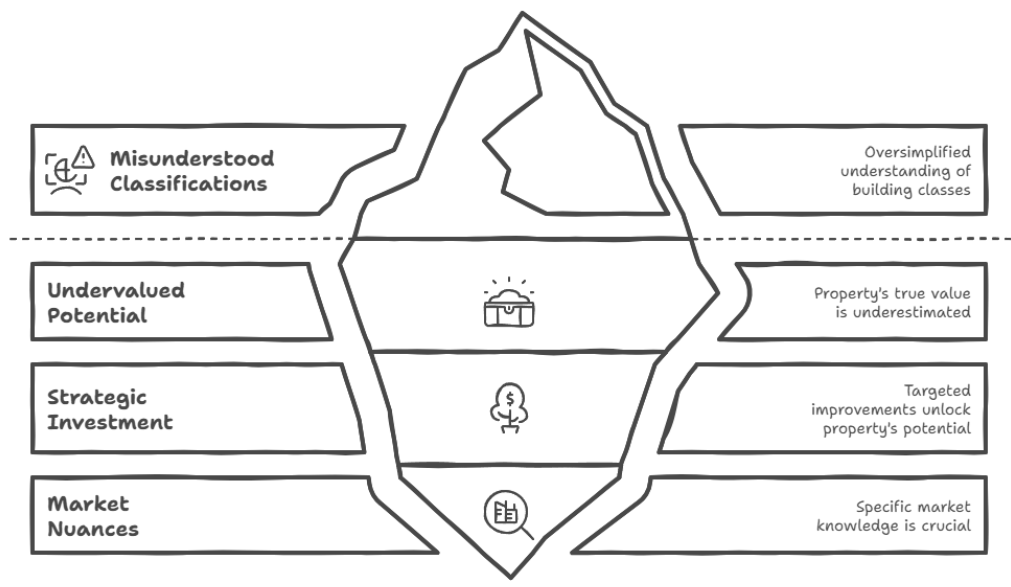
I almost passed on it. The asking price seemed high for what appeared to be a pretty average building. But something nagged at me about the classification. After digging deeper into comparable properties and really understanding what determined building classes in that specific market, I realized the listing was actually undervaluing the property’s potential.
We ended up acquiring it, invested strategically in targeted improvements, and repositioned it as a true Class A property. The transformation took about 18 months and cost less than I’d initially feared. Today, that building commands some of the highest rents in the submarket and maintains a waiting list for space. More importantly, it taught me that understanding building classifications isn’t just academic knowledge – it’s a practical tool that can uncover opportunities others miss.
The problem is, most people think they understand what Class A, B, and C mean, but the reality is much more nuanced. These classifications affect everything from rental rates to financing options to exit strategies, yet they’re often misunderstood or oversimplified.
What Class A Really Means
When most people hear “Class A,” they picture gleaming skyscrapers with marble lobbies and Fortune 500 tenants. And while that’s often accurate, it’s not the complete picture. Class A designation is really about being the best option available in a given market at a given time.
I’ve seen 20-story towers in smaller markets that qualify as Class A, and I’ve seen buildings in Manhattan that, despite their prestigious addresses, really function more like Class B properties due to age and condition. The key is understanding that Class A means top-tier for that specific market.
The physical characteristics are important, of course. We’re talking about buildings with modern infrastructure – HVAC systems that actually work efficiently, elevators that don’t make you late for meetings, and technology infrastructure that can handle today’s business needs. The finishes are high-quality, the layouts are efficient, and everything feels current rather than dated.
But what really defines Class A properties is the tenant experience they deliver. These buildings make business easier for their occupants. Parking is convenient, building management is responsive, and systems work reliably. The common areas create a professional atmosphere that companies are proud to call their address.
From an investment perspective, Class A buildings typically offer the most predictable returns. They attract the most creditworthy tenants, achieve the highest rents, and maintain the best occupancy rates. But they also come with the highest acquisition costs and the lowest yield potential. You’re paying for stability and prestige, not explosive growth.
Class B: The Sweet Spot for Many Investors
Class B buildings often represent the best value proposition in commercial real estate, both for tenants and investors. These properties offer professional environments at more reasonable rents, and they frequently provide the best opportunities for value creation through strategic improvements.
The infrastructure in Class B buildings is functional but may not be state-of-the-art. The HVAC works, but it might not be the most efficient system available. The elevators get you where you need to go, but they might be slower than what you’d find in a Class A property. The finishes are professional but not luxurious.
What I find interesting about Class B properties is how much potential they often contain. A relatively modest investment in lobby improvements, common area upgrades, or amenity additions can dramatically improve tenant satisfaction and rental rates. I’ve seen buildings move from solid B to B+ or even A- status with the right improvements.
The tenant mix in Class B buildings tends to be diverse – established businesses that prioritize value, growing companies that need professional space but aren’t ready for Class A rents, and sometimes larger companies placing satellite offices or back-office functions. This diversity can actually be a strength from a risk management perspective.
For investors, Class B properties often offer the best balance of current income and upside potential. You can generate decent cash flow while working on improvements that enhance the property’s competitive position. The key is identifying buildings where strategic investments can meaningfully improve the tenant experience and market positioning.
Class C: High Risk, High Reward
Class C buildings are where things get interesting from an investment perspective. These properties typically feature older infrastructure, limited amenities, and below-market rents. They often require significant investment to bring them up to current standards, but they can offer substantial returns for investors willing to do the work.
The infrastructure challenges in Class C buildings are real. You might be dealing with outdated electrical systems, inefficient HVAC, or elevators that need constant maintenance. The building envelope might need attention – roof repairs, window replacements, or facade improvements. Parking could be limited, and the common areas likely need updating.
But here’s what makes Class C properties appealing: the acquisition costs are lower, the improvement opportunities are substantial, and the potential for rent increases can be significant. I’ve worked on Class C repositioning projects where we’ve doubled or tripled rental rates over a few years through strategic improvements and better management.
The tenant base in Class C buildings often includes smaller businesses, startups, non-profits, and companies with tight budget constraints. While this can mean higher turnover and collection challenges, it can also mean working with entrepreneurial, growing businesses that could become long-term success stories.
The key with Class C investments is having a clear vision for what the property can become and a realistic budget for getting there. These projects almost always cost more and take longer than initially planned, so conservative underwriting is essential.
Location Still Trumps Everything
Here’s something that surprises many new investors: a beautifully maintained building in a declining area will struggle to achieve high classification status, while a modest building in a prime location can command premium rents and tenant interest.
Location affects building classification in multiple ways. Accessibility matters – is the building easy to reach by car and public transportation? Is parking adequate? Are there restaurants, services, and amenities nearby that tenants value? What’s the neighborhood’s trajectory – improving, stable, or declining?
I’ve seen this play out dramatically in gentrifying areas. Buildings that were solid Class C properties in transitioning neighborhoods suddenly found themselves reclassified as Class B or even Class A as the surrounding area improved. The buildings themselves didn’t change, but their competitive position within the market shifted significantly.
Demographics matter too. Class A buildings need to be in areas that can support the rent levels they charge. A building with every Class A amenity won’t succeed if it’s surrounded by businesses and residents who can’t afford premium rents.
The competitive landscape is crucial for classification. A building that would be Class A in a secondary market might only rank as Class B in a major metropolitan area with newer, more impressive properties. Context is everything.
The Management Factor
Property management quality can elevate or diminish a building’s effective classification regardless of its physical attributes. I’ve seen Class A buildings feel like Class B properties due to poor management, and Class B buildings that outperform their classification through exceptional management.
Good management shows up in multiple ways: responsive maintenance, professional communication, clean and well-maintained common areas, and proactive problem-solving. Great management creates an environment where tenants want to stay and potential tenants want to move in.
Building management also affects operational efficiency, which impacts profitability. Well-managed buildings typically achieve higher occupancy rates, longer average lease terms, and fewer costly emergency repairs. They also tend to attract higher-quality tenants who value professionalism and reliability.
I always pay close attention to management quality when evaluating acquisition opportunities. A great management team can unlock value in an underperforming property, while poor management can destroy value even in a great building.
Investment Implications
Understanding building classifications is crucial for making sound investment decisions. Class A properties offer stability and prestige but limited upside potential. They’re appropriate for investors seeking steady income and capital preservation, often institutional investors or individuals nearing retirement who prioritize predictability over growth.
Class B properties frequently offer the best balance of current income and value creation opportunities. They can generate solid cash flow while providing opportunities to enhance value through strategic improvements. These properties appeal to investors who want some upside potential without taking on major redevelopment risk.
Class C properties are for investors willing to take on more risk in exchange for potentially higher returns. These deals often require active management, significant capital investment, and patience to realize the full potential. They’re best suited for experienced investors with the resources and expertise to execute repositioning strategies.
The financing landscape varies significantly across building classes. Class A properties typically qualify for the most favorable loan terms – lower rates, higher loan-to-value ratios, and longer amortization periods. Class C properties may require more expensive financing or alternative lending sources, especially if they need significant improvements.
Regional and Market Variations
Building classifications aren’t standardized across markets, which creates both challenges and opportunities for investors. What qualifies as Class A in one city might only rate as Class B in another market with higher standards or more competition.
I’ve learned to focus more on relative positioning within a specific market than absolute classification standards. A building that’s the best available option in its submarket will perform well regardless of how it might rank in a different city.
Understanding local market dynamics is essential. Some markets have clear classification standards that most brokers and appraisers agree on. Others have more subjective or fluid standards that can vary depending on who’s making the evaluation.
This variation can create opportunities for investors who understand multiple markets. A building that’s considered Class B in an expensive primary market might command Class A rents if repositioned in a secondary market with different competitive dynamics.
Making Classifications Work for You
For Class A properties, the strategy focuses on maintaining competitive advantages and optimizing operations. This means staying current with technology, maintaining high service standards, and anticipating tenant needs before they become problems. Regular capital improvements help maintain the property’s market position.
Class B properties offer the most strategic flexibility. You can maintain them as solid Class B assets with good returns, or you can invest in improvements that move them toward Class A status. The key is understanding which improvements will provide the best return on investment in your specific market.
Class C properties require the most active strategy. Success usually involves some combination of physical improvements, management upgrades, and tenant repositioning. These projects can be very rewarding but require careful planning and sufficient capital reserves for unexpected issues.
The Bottom Line
Building classifications matter because they affect every aspect of commercial real estate investment – from acquisition costs to financing options to exit strategies. But they’re not rigid categories carved in stone. They’re relative rankings that depend on market conditions, competitive landscapes, and management quality.
The most successful investors understand these classifications well enough to spot opportunities others miss. Maybe it’s a Class B building that could become Class A with the right improvements. Maybe it’s a Class A building that’s been mismanaged and is underperforming its potential. Or maybe it’s a Class C property in a gentrifying area that’s positioned for significant appreciation.
The key is looking beyond the surface classification to understand what drives value in your specific market. Buildings don’t exist in isolation – they’re part of complex market ecosystems where location, management, tenant mix, and timing all interact to determine success.
Understanding these dynamics won’t guarantee success in commercial real estate, but it will help you make more informed decisions and spot opportunities that others overlook. And sometimes, that’s the difference between a good investment and a great one.

