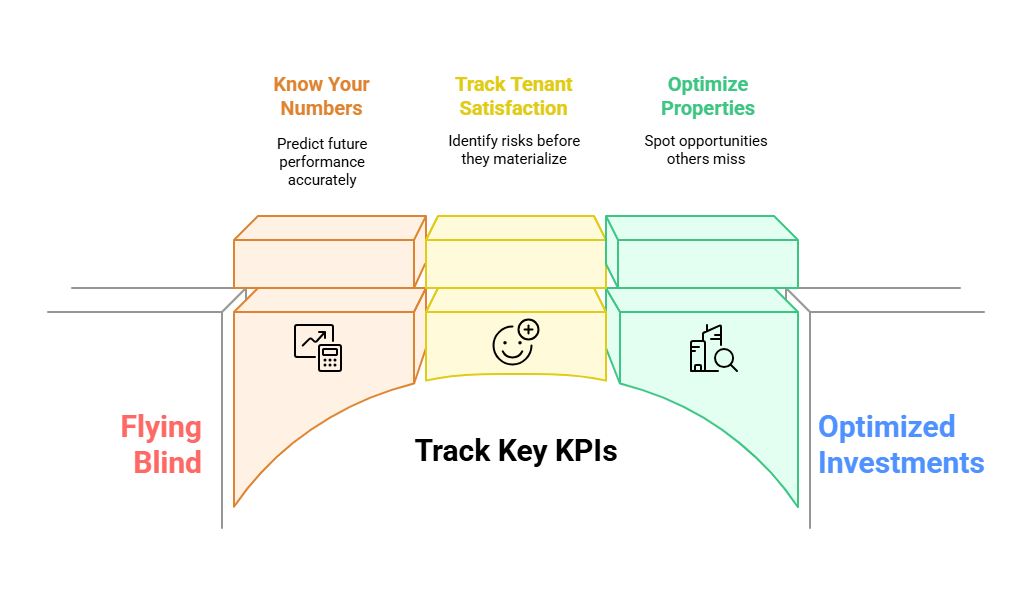
Look, I’ll be straight with you. Most commercial real estate investors are flying blind. They buy properties, collect rent, and hope things work out. That’s not investing—that’s gambling.
I’ve been in this game for over fifteen years, managing everything from Oklahoma commercial buildings to high-rise offices in major metros, and I can tell you the difference between guys making decent money and guys making serious money comes down to one thing: they know their numbers. Not just the obvious ones like rent rolls and expenses, but the metrics that actually predict what’s going to happen next.
Last month, I was at a CCIM meeting where this developer was bragging about his “stable” office building. Great occupancy, tenants paying on time, everything looked perfect. Two weeks later, he called me in a panic. Three major tenants gave notice the same week. Turns out his tenant satisfaction scores had been tanking for months—he just never bothered to track them.
That’s the difference between managing properties and optimizing them. When you track the right KPIs, you see problems coming six months before they hit your bottom line. More importantly, you spot opportunities that other investors miss entirely.
Deep Dive: Key KPIs for Office Properties
Office properties are going through their biggest transformation since the invention of the elevator. The pandemic accelerated trends that were already reshaping how businesses use space. Hybrid work, emphasis on collaboration, flight to quality—everything’s changing.
This means your traditional office metrics need to evolve. You can’t just track rent per square foot and think you understand your market position. Today’s successful office properties require a more sophisticated measurement approach.
Rent Per Square Foot (PSF)
Rent PSF is still the primary revenue driver for office properties, but the market has gotten much more complex. You can’t just look at asking rents anymore—you need to understand what’s actually being achieved in signed leases.
I track three different PSF metrics: asking rent, effective rent (factoring in concessions), and net effective rent (including tenant improvement allowances). The gaps between these numbers tell you everything about market conditions and your negotiating position.
Take my Class B building in suburban Atlanta. Asking rents are $26 PSF, but effective rents are averaging $22 PSF after concessions. That 15% difference tells me we’re in a tenant-favorable market where competition is driving up incentives.
The key is benchmarking against truly comparable properties. I don’t just look at other office buildings—I look at buildings with similar floor plates, parking ratios, amenities, and tenant profiles. That’s how you set rents that maximize both occupancy and revenue.
Lease Renewal Rate
In office properties, lease renewal rates are critical because office tenants typically require significant capital investment. When a tenant doesn’t renew, you’re not just losing rent—you’re facing substantial re-leasing costs.
I track renewal rates by tenant size and lease term. Small tenants (under 3,000 SF) typically have lower renewal rates but require less capital to replace. Large tenants (over 10,000 SF) usually have higher renewal rates but cost more if they leave.
My approach to improving renewal rates starts 18 months before lease expiration. We do annual tenant satisfaction surveys, address maintenance issues immediately, and maintain regular contact with tenant decision-makers. This proactive approach has helped me achieve renewal rates above 80%, even in competitive markets.
Tenant Improvement (TI) Allowance Spend
TI allowances represent one of the biggest capital expenses in office properties. These have increased significantly as tenants demand more sophisticated buildouts and landlords compete for quality tenants.
I track TI spend per square foot by tenant size and lease term. Smaller tenants typically need higher TI allowances per square foot because they can’t spread design and construction costs across as much space. Longer-term leases justify higher TI allowances because you have more time to recover the investment.
The key is structuring TI allowances to maximize ROI. I prefer graduated allowances tied to lease terms—more money for longer commitments. I also negotiate clawback provisions that recover unused allowances if tenants terminate early.
Utility Consumption & Energy Efficiency
Energy costs are a significant portion of operating expenses in office properties. More importantly, energy efficiency has become a key differentiator in attracting and retaining tenants.
I track utility consumption per square foot and benchmark against Energy Star ratings for similar properties. This helps identify efficiency improvement opportunities and provides data to support rent premiums for high-performance buildings.
In my Houston office building, I invested $180,000 in LED lighting and smart HVAC controls that reduced energy consumption by 19%. The annual savings of $28,000 improved NOI, but the real benefit was tenant satisfaction and our ability to market the building as environmentally responsible.
Deep Dive: Key KPIs for Retail Properties
Retail real estate has been completely transformed. The old model of passive landlords collecting rent while tenants figure out their own success is dead. Today’s retail properties require active management and deep understanding of tenant performance.
Successful retail properties help their tenants succeed. This means tracking metrics that go beyond traditional landlord concerns to include tenant sales performance, customer behavior, and the overall shopping experience.
Sales Per Square Foot (PSF)
Sales PSF is the most important metric for retail properties because it directly correlates with tenant health and rent sustainability. Strong sales PSF indicates a tenant can afford their rent and justify expansion or renewal.
I require all retail tenants to provide monthly sales reports, which I use to calculate sales PSF for each tenant and the overall property. This data helps me identify struggling tenants early and work with them to improve performance.
For example, I noticed one restaurant tenant’s sales PSF had dropped 20% over four months. Rather than waiting for them to default, I worked with them to analyze foot traffic patterns and adjust their operating hours. Their sales recovered, and they’ve since signed a five-year extension.
Industry benchmarks vary significantly by retail category, but I generally look for sales PSF of at least $250 for clothing retailers and $400+ for food and beverage concepts. Tenants below these thresholds need immediate attention.
Foot Traffic & Conversion Rates
Foot traffic is the lifeblood of retail properties. Without customers, even the best tenants will struggle. I track foot traffic using door counters and mobile analytics to understand patterns and identify opportunities.
But foot traffic alone isn’t enough—you need to know how many visitors become customers. That’s where conversion rates come in. I work with tenants to track their conversion rates and identify factors that improve performance.
Seasonal patterns are particularly important. Understanding seasonal variations in foot traffic helps with tenant mix decisions and marketing strategies. Tax preparation services perform well in Q1, while costume shops peak in Q4.
Percentage Rent Share
Percentage rent clauses align landlord and tenant interests by giving landlords a share of sales above a certain threshold. This creates incentive for both parties to work together to drive sales.
I structure percentage rent deals carefully, setting breakpoints that are achievable but meaningful. The goal is to participate in tenant success while providing downside protection through base rent.
In my experience, percentage rent works best with food and beverage tenants, seasonal retailers, and new concepts that might not have established credit. It’s also useful for expanding existing tenants who want to test new markets.
Tenant Mix Effectiveness
Tenant mix is both art and science. The goal is creating a combination of tenants that attract customers, encourage longer visits, and generate cross-shopping opportunities.
I evaluate tenant mix effectiveness through customer surveys, sales performance, and foot traffic analysis. The best retail properties have anchor tenants that draw customers, convenience tenants that serve daily needs, and experiential tenants that create reasons to linger.
I repositioned a struggling shopping center last year by replacing three underperforming tenants with a fitness concept, a craft brewery, and a gourmet market. The fitness concept brought regular customers who also used the brewery and market. Sales PSF increased 30% across all tenants.
Deep Dive: Key KPIs for Industrial Properties
Industrial real estate has become the star performer in commercial real estate, driven by e-commerce growth and supply chain evolution. But success in industrial requires understanding operational metrics that don’t apply to other property types.
Modern industrial tenants are sophisticated operators who need buildings that support complex logistics operations. This means tracking metrics that reflect operational efficiency, not just occupancy and rent.
Warehouse Utilization Rate
Warehouse utilization measures how effectively tenants use their space. It’s calculated by dividing used storage capacity by total available capacity. High utilization rates indicate efficient operations and justify higher rents.
I work with industrial tenants to optimize utilization through layout improvements, racking systems, and operational consulting. In one facility, we increased utilization from 68% to 82% by reconfiguring the layout and installing high-density storage systems.
Higher utilization rates benefit both landlords and tenants. Tenants get more storage capacity without additional rent. Landlords get tenants who are more efficient and less likely to need additional space elsewhere.
Clear Height & Column Spacing
These technical specifications are critical for industrial properties. Clear height determines how high goods can be stacked, while column spacing affects layout flexibility and equipment operation.
Modern distribution centers require clear heights of 32+ feet to accommodate high-density storage systems. Older buildings with lower clear heights are becoming obsolete for many logistics operations.
Column spacing is equally important. Wide spacing (60+ feet) allows for flexible layouts and efficient forklift operation. Tight spacing creates bottlenecks and limits operational efficiency.
I’ve seen tenants pay rent premiums of 10-20% for buildings with superior clear heights and column spacing. These technical specifications directly impact operational efficiency and justify higher rents.
Dock Door Ratio
Dock door ratio measures the number of loading docks relative to building size. It’s typically expressed as one dock door per X square feet of building space.
The optimal ratio depends on the tenant’s operation. Cross-dock facilities need high ratios (1:5,000 SF or better) to handle rapid turnover. Long-term storage facilities can operate with lower ratios (1:15,000 SF).
I evaluate dock door ratios during acquisition to ensure buildings can serve their intended use. Buildings with insufficient dock doors face significant capital expenditure to add capacity or rental discounts due to operational limitations.
Throughput & Turnaround Time
These operational metrics reflect tenant efficiency and satisfaction. Throughput measures how much product moves through the facility, while turnaround time measures how quickly trucks are loaded and unloaded.
I don’t directly control these metrics, but I work with tenants to optimize them through facility improvements. Better truck circulation, expanded staging areas, and improved dock equipment can significantly impact operational efficiency.
Tenants with efficient operations are more successful and more likely to renew leases. They’re also more likely to expand operations or refer other businesses. Investing in operational efficiency creates value for both landlords and tenants.
Implementing a Robust KPI Tracking System
Having the right KPIs is only valuable if you can track them consistently and accurately. I’ve learned this lesson the hard way—good intentions without good systems lead to abandoned initiatives and missed opportunities.
The foundation of effective KPI tracking is choosing the right technology platform. I’ve used everything from Excel spreadsheets to sophisticated property management software. The key is finding a system that balances functionality with usability.
For small portfolios, a well-designed spreadsheet might work. But as you grow, you need integrated systems that automate data collection and provide real-time reporting. I currently use a combination of property management software and specialized analytics tools.
The most important aspect is data quality. Garbage in, garbage out. I’ve established clear protocols for data entry, regular audit procedures, and training programs for all team members. Everyone needs to understand why accurate data matters and how their role contributes to the bigger picture.
Leveraging KPIs for Strategic Decision-Making
Data collection is just the beginning. The real value comes from turning information into action. I’ve developed a systematic approach to using KPIs for strategic decision-making.
First, I establish benchmarks for each KPI based on historical performance, market data, and property-specific factors. These benchmarks become the basis for identifying opportunities and problems.
Second, I create exception reports that highlight KPIs that fall outside acceptable ranges. This allows me to focus attention on properties that need immediate attention while avoiding micromanagement of performing assets.
Third, I use KPI trends to predict future performance and identify investment opportunities. Declining tenant satisfaction scores often precede increased vacancy rates by 6-12 months. This early warning allows me to address problems before they impact financial performance.
Your Roadmap to Property Performance Excellence
After fifteen years in commercial real estate, I can tell you that the difference between good and great performance comes down to information. The most successful properties aren’t necessarily in the best locations—they’re the ones with the best data-driven management.
The KPIs I’ve outlined here aren’t just numbers on a spreadsheet. They’re the tools that help you see around corners, spot opportunities before your competition, and build wealth through superior property performance.
Start with the universal KPIs—NOI, cap rate, occupancy, and tenant retention. Master these fundamentals before moving to property-specific metrics. Build systems that ensure data quality and consistency. Most importantly, use the information to make better decisions.

