Why Estimating Returns Feels Complex (But Doesn’t Have to)
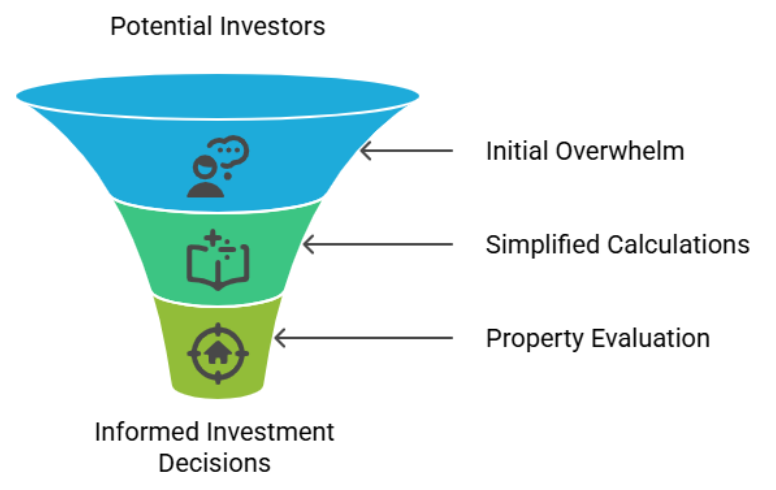
Real estate numbers hit you like a freight train when you’re starting out. Cap rates, NOI, cash flow analysis – honestly, it’s like they invented these terms just to scare people away from property investment. I’ve watched so many potential investors get completely overwhelmed by spreadsheets and formulas before they even look at their first rental property.
Here’s what nobody tells you: you don’t need to be a math genius or have some fancy real estate calculator to figure out if a property makes sense. After dealing with hundreds of investment properties, I’ve learned that a handful of simple calculations can tell you everything you need to know about whether a deal is worth your time.
What This Guide Will Cover
Look, I’m going to show you exactly how I screen properties without getting lost in complicated financial models. We’ll cover the basic calculations that actually matter – gross rental yield, cap rates, and cash-on-cash returns. But more importantly, I’ll explain what these numbers really mean in the real world and how to spot the non-obvious stuff that can make or break your investment returns.
By the time we’re done here, you’ll know how to quickly evaluate any rental property deal that comes your way.
Why Simple Estimates Matter in Property Investment
The Power of Quick Screening
Property deals move fast. Really fast. You can’t spend three days running detailed financial projections on every single listing that pops up in your inbox. That’s where these quick calculations become absolute game-changers for real estate investing.
I remember this one time early on when I got excited about a duplex that looked perfect on paper. Great neighborhood, decent asking price, solid rental history. But when I ran a quick gross yield calculation right there in my car, the numbers were terrible. The potential rental income wouldn’t even cover the mortgage payments, let alone property taxes and maintenance costs. That five-minute calculation saved me from wasting an entire weekend on due diligence for a deal that never had a chance.
A Starting Point, Not the Final Say
Here’s the thing about these simple methods – they’re screening tools, not crystal balls. Think of them like dating apps for real estate investment. They help you figure out which properties deserve a second look, but you’re not marrying anyone based on their profile alone.
These calculations give you solid estimates for comparing investment opportunities and deciding what’s worth deeper analysis. But they’re not replacing proper due diligence, property inspections, or detailed market research. They’re just helping you avoid wasting time on obvious losers while identifying the potential winners in your investment portfolio.
Your Go-To Simple Property Return Methods
Gross Rental Yield: The Easiest Starting Point
This is probably the fastest way to evaluate any rental property. Gross rental yield shows you the basic relationship between what you pay for a property and what it brings in annually. Take your expected annual rental income and divide it by the purchase price. That’s it.
Say you’re looking at a $250,000 house that should rent for $1,800 per month. Your annual rental income would be $21,600, so your gross yield is 8.6%. Not bad for a quick calculation you can do in your head while standing in the property.
The obvious downside here is that gross yield completely ignores operating expenses. No property taxes, insurance, repairs, vacancy allowances – nothing. It’s purely about gross rental income versus purchase price. But that’s exactly why I love it as a first filter. If a property can’t even hit my minimum gross yield threshold, I know the net numbers are going to be even worse once I factor in all the real-world costs of property ownership.
Capitalization Rate (Cap Rate): A Step Deeper
Cap rate takes things up a notch by including your operating expenses in the calculation. You take your net operating income (rental income minus all expenses except financing) and divide it by the property price. This gives you a much clearer picture of the property’s actual earning potential.
Using that same $250,000 property with $21,600 in annual rent, let’s say your operating expenses (taxes, insurance, maintenance, property management, vacancy allowance) total $7,500 per year. Your NOI becomes $14,100, giving you a cap rate of 5.6%.
Cap rates are fantastic for comparing similar properties in the same market. They show you what kind of return you’d get if you bought the property with all cash. What makes a “good” cap rate really depends on your local real estate market. In expensive coastal areas, you might be happy with 4-5% cap rates because you’re betting on property appreciation. In smaller Midwest markets, I’d want to see 8-10% or higher since cash flow is usually the main attraction.
Cash-on-Cash Return: Focusing on Your Cash Flow
This is where the rubber meets the road for most real estate investors. Cash-on-cash return tells you exactly what kind of return you’re getting on the actual cash you put into the deal. It’s your annual cash flow divided by your total cash investment.
Let’s stick with our example property. If you put down 20% ($50,000) plus $6,000 in closing costs and immediate repairs, your total cash invested is $56,000. With an NOI of $14,100 and annual mortgage payments of $9,600, your cash flow is $4,500. That gives you a cash-on-cash return of about 8%.
This metric is crucial because it shows you the real-world performance of your leveraged investment. It’s the number that determines whether you’re actually making money or just treading water with your rental property business.
Beyond the Numbers: Essential Factors Influencing Return
Location, Location, Location (It’s More Than a Cliché)
Yeah, I know everyone says this, but location really does trump everything else in real estate investment. You can’t capture the impact of good schools, job growth, crime rates, or future development plans in a simple calculation. But these factors directly affect your vacancy rates, tenant quality, and long-term property appreciation.
I’ve owned properties where the initial cash flow looked mediocre on paper, but the location was in a rapidly growing area with major employers moving in. Those properties ended up being some of my best performers because both rents and property values increased faster than the market average. No cap rate calculation would have predicted that kind of performance.
Market Conditions and Trends
Local market trends can make or break your investment returns. Are rents rising or falling? Is the local economy adding jobs or losing them? Are new apartment complexes being built that might increase competition for tenants?
I always check recent rental listings and sales data before getting serious about any property. If I see rents dropping or properties sitting on the market for months, that’s a red flag that my projections might be too optimistic. On the flip side, if I notice rents increasing and properties selling quickly, that suggests there’s strong rental demand that could support rent growth.
Property Condition and Potential (The “Hidden Costs”)
The physical condition of any investment property can completely change your actual returns. That older roof, outdated electrical system, or foundation issues can eat up thousands of dollars that weren’t in your original calculations.
I learned this lesson the expensive way on one of my early properties. The numbers looked great until I discovered the HVAC system was on its last legs and needed a $8,000 replacement six months after closing. That single unexpected expense killed my cash flow for the entire first year.
Now I always budget for capital expenditures and major repairs, even on properties that look to be in good condition. Better to be pleasantly surprised than caught off guard by a major repair bill.
Using Simple Estimates to Make Smarter Initial Decisions
Comparing Apples to Apples (and Oranges)
These metrics really shine when you’re comparing multiple investment opportunities. You might find that Property A has a lower gross yield but better cap rate due to lower operating costs. Property B might offer great cash-on-cash returns because of favorable financing terms, but the cap rate is just average.
Each calculation tells you something different about the investment potential. Gross yield gives you the quick screening number. Cap rate shows operational efficiency and market competitiveness. Cash-on-cash return reveals the actual impact on your personal finances and investment portfolio.
When a Simple Estimate Says “Dig Deeper” or “Walk Away”
These calculations aren’t just academic exercises – they’re decision-making tools. A property with a terrible gross yield compared to market norms is usually an immediate pass unless there’s some obvious value-add opportunity you can execute.
But when I see numbers that are significantly better than typical market returns, that’s my signal to dig deeper. Maybe there’s something I’m missing, or maybe I’ve found a genuinely good deal. Either way, those outlier numbers deserve investigation.
If the basic math doesn’t work at a high level, it’s probably not going to work when you get into the details. But when the simple calculations show promise, that’s when it’s worth investing time in property inspections, detailed financial modeling, and serious due diligence.
Conclusion: Getting Started with Confidence
Property investment analysis doesn’t have to be complicated right from the start. These three simple calculations – gross rental yield, cap rate, and cash-on-cash return – give you powerful tools for quickly evaluating potential deals and comparing investment opportunities.
Remember that numbers are just part of the story. Location quality, market trends, and property condition all play crucial roles in determining your actual investment returns. But having these basic calculations in your toolkit means you can quickly separate the potential winners from the obvious losers.
The best part? You can do all of these calculations on your phone while you’re standing in a property or sitting in your car after a showing. Start with one method and practice it on every property listing you see. Pretty soon, you’ll be able to spot good deals and avoid bad ones almost automatically.
Which calculation are you going to try first on your next property lead?

